
The wellness industry offers opportunities for individuals interested in personal care, relaxation services, massage, and professional spa treatments. For students who want to build knowledge in this field, choosing a structured Diploma in Spa Therapist can be a useful way to develop fundamental skills and understand professional spa practices.
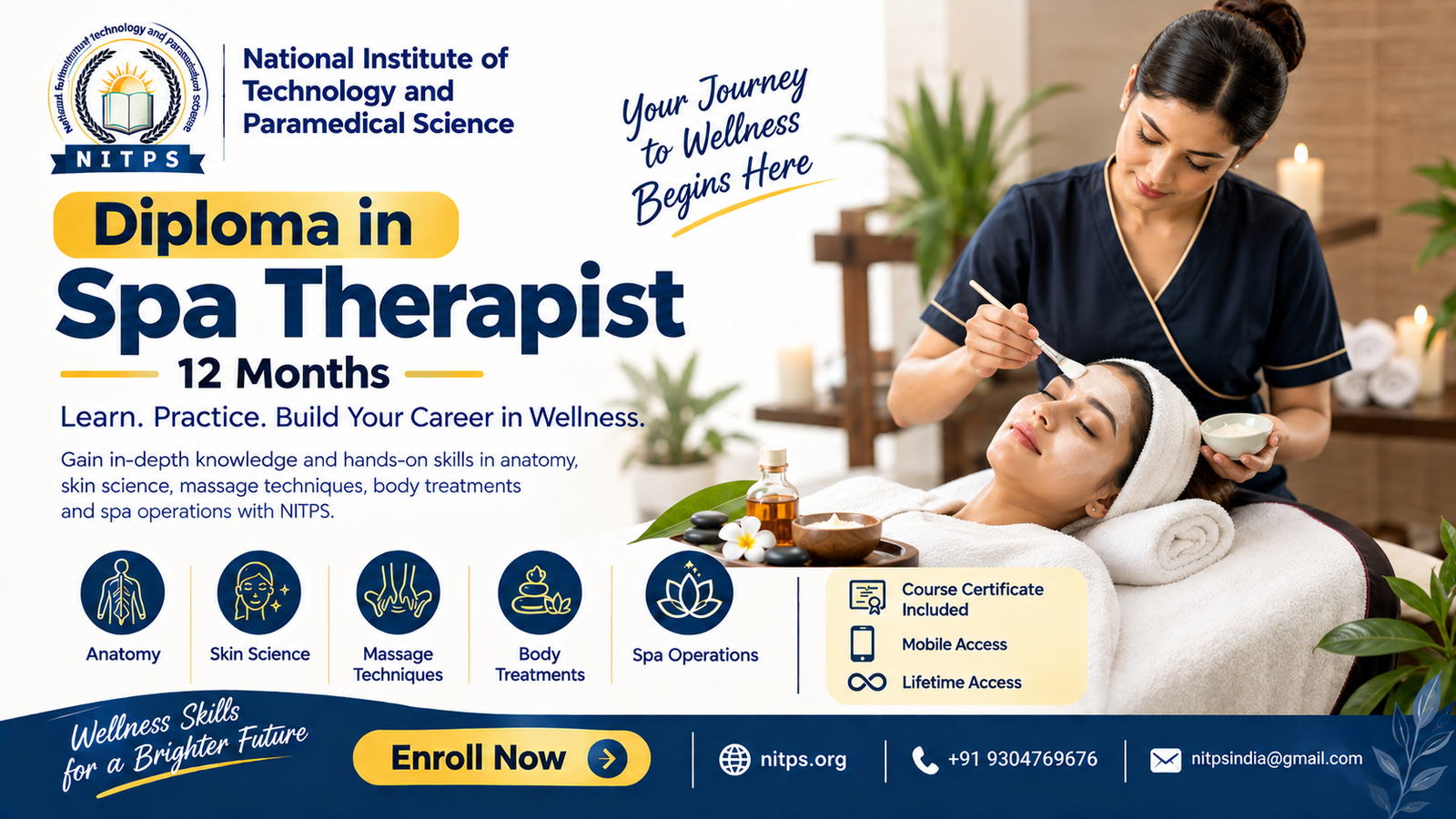
NITPS offers a 12-month Diploma in Spa Therapist that combines theoretical learning with hands-on practice. The program covers areas such as anatomy, skin science, massage techniques, body treatments, and spa operations. The course also includes a certificate, lifetime access, and mobile access.
What Is a Diploma in Spa Therapist?
A Diploma in Spa Therapist is a career-oriented course designed to introduce students to the fundamental concepts of spa therapy and wellness services. It helps learners understand the human body, basic skin science, massage methods, body treatments, and the operational side of a professional spa environment.
Rather than focusing on only one treatment, a comprehensive Spa Therapist Course can introduce learners to several areas that are relevant to spa and wellness services.
Why Choose a Spa Therapist Course?
The spa and wellness sector requires professionals who understand both client care and treatment procedures. Learning through a structured program can help students develop a better understanding of professional practices before entering the workplace.
A Diploma in Spa Therapy may be suitable for learners who are interested in massage, wellness, personal care, body treatments, and spa services. It can also provide a foundation for learners who want to develop specialized skills in the future.
What Will You Learn in a Diploma in Spa Therapist?
The NITPS program covers several important areas related to spa therapy.
1. Anatomy
Basic knowledge of anatomy is important for understanding the human body and how massage and body treatments relate to different body areas. Studying anatomy can help learners develop a stronger theoretical foundation for spa therapy.
2. Skin Science
Skin science introduces learners to fundamental concepts related to the skin. This knowledge can be useful when understanding personal care and different types of spa treatments.
3. Massage Techniques
Massage is one of the key areas of spa therapy. Students can learn the principles and techniques associated with professional massage services as part of their structured training.
4. Body Treatments
Body treatments form another important part of spa and wellness services. Learning about different treatment procedures can help students understand how professional spa services are organized.
5. Spa Operations
Professional spa services also require knowledge of day-to-day operations. Understanding basic spa procedures and service practices can help learners become familiar with the professional environment.
Importance of Practical Training
Spa therapy is a skill-based field where practical understanding is important. Reading about a technique and understanding how it is applied are two different aspects of learning.
The NITPS Diploma in Spa Therapist combines classroom theory with hands-on practice, allowing learners to study concepts while also developing practical-oriented understanding.
This combination can help students connect theoretical knowledge with practical applications in wellness and spa settings.
Who Can Consider a Diploma in Spa Therapist?
A Spa Therapist Course can be considered by individuals interested in:
- Spa and wellness services
- Massage therapy
- Body treatments
- Personal care
- Beauty and wellness
- Professional spa environments
- Developing wellness-related skills
It may also be useful for learners looking for a new skill area or planning to explore opportunities in the wider wellness sector.
Career Opportunities After Spa Therapy Training
Completing a course with certificate can provide learners with structured knowledge that may be useful when exploring entry-level opportunities in the wellness sector.
Depending on their skills, experience, and applicable employment requirements, learners may explore roles or work environments such as:
- Spa and wellness centres
- Resorts
- Hotels and hospitality establishments
- Beauty and wellness centres
- Massage and body-care facilities
- Personal wellness services
Additional experience and specialized training can further help learners develop their professional capabilities.
Why Certification Can Be Useful
A certificate provides documentation that a learner has completed a particular educational or training program. When choosing a course with certificate, students should consider the course curriculum, duration, practical training, learning resources, and certification details.
The NITPS Diploma in Spa Therapist is a 12-month program and lists a certificate as one of its features. It also provides lifetime and mobile access to the course.
How to Choose the Right Spa Therapy Course
Before enrolling in a spa therapy program, prospective students should compare important factors such as:
Course duration: Check whether the duration provides sufficient time to understand the subject.
Course curriculum: Look for subjects covering relevant areas such as anatomy, massage, skin science, body treatments, and spa operations.
Practical learning: Consider whether the course includes practical-oriented learning.
Certification: Check what type of certificate is provided after successful completion.
Learning flexibility: Mobile or online access can be useful for students who need flexible study options.
Start Learning Spa Therapy Skills
Building a career in wellness can begin with developing a strong foundation in relevant skills and knowledge. A structured Diploma in Spa Therapist can introduce learners to anatomy, skin science, massage techniques, body treatments, and spa operations in one program.
The NITPS 12-month program is designed around these areas and combines theoretical learning with hands-on practice.
Conclusion
A Diploma in Spa Therapist can be a suitable learning option for individuals interested in the spa, wellness, massage, and personal care sectors. Developing knowledge of anatomy, skin science, massage techniques, body treatments, and spa operations can help learners build a foundation for further skill development.
For learners searching for a Spa Therapist Course with structured training and certification, the NITPS 12-month program provides an opportunity to study key aspects of spa therapy while gaining practical-oriented knowledge.